
Cite Check
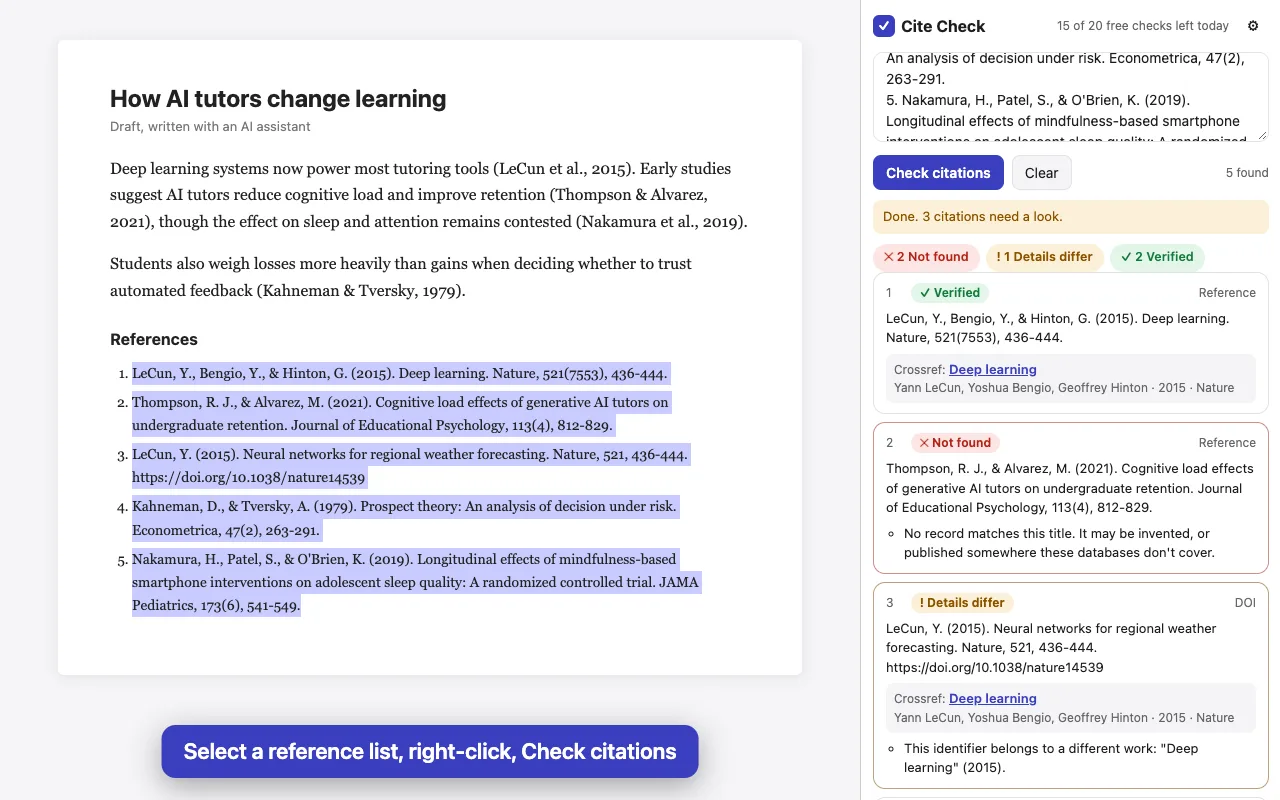
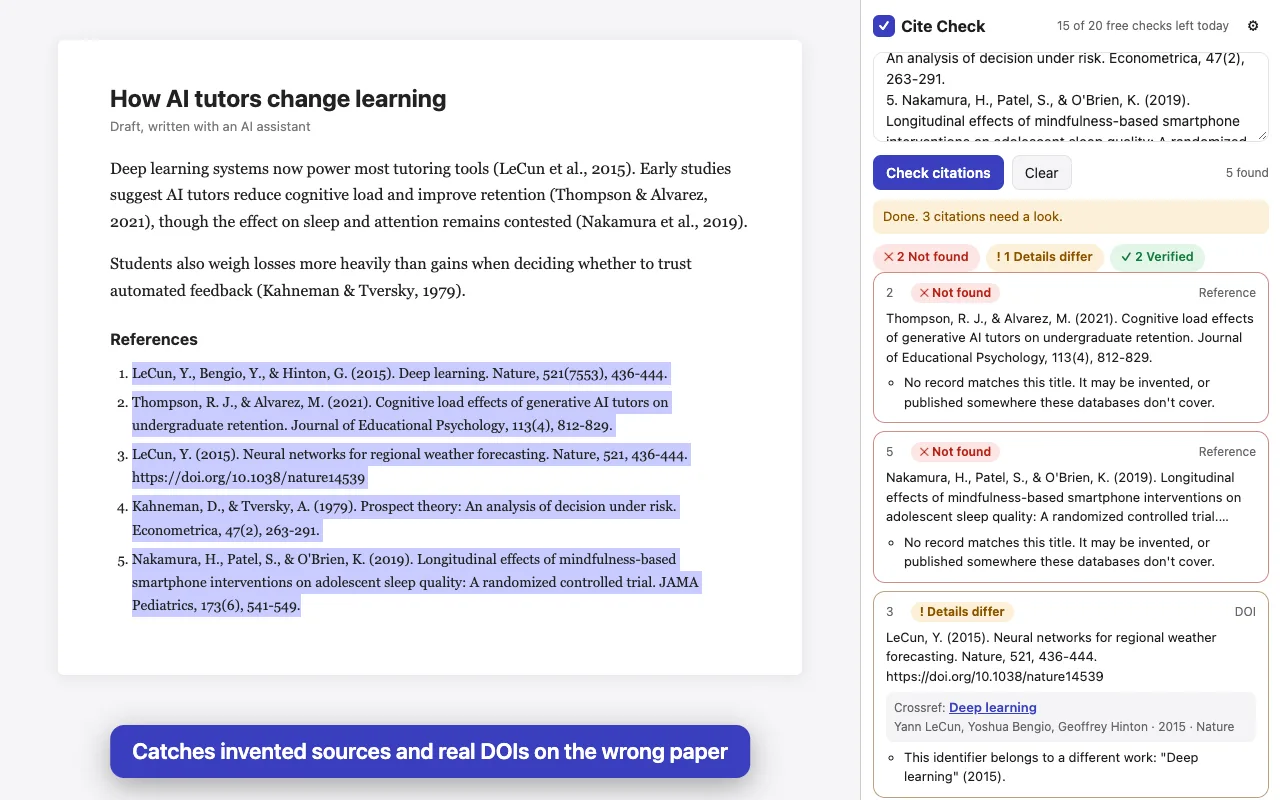
AI answers invent sources that look real. Select a reference list or any text with citations, right-click, and Cite Check tells you which sources exist, which are made up, and which have the wrong details.
Free for 20 citations a day. Pro is $29 a year.
What it checks
- References in any styleAPA, MLA, Chicago, IEEE, Vancouver, and the bullet lists AI answers write. Each is matched by title, year and first author against Crossref, OpenAlex and Open Library.
- IdentifiersDOIs, arXiv and PubMed IDs, and ISBNs are looked up directly.
- Real IDs on the wrong sourceA common AI mistake: a real DOI attached to a different paper. Cite Check compares the record with what the text claims and shows what differs.
- US court casesWith Pro and a free CourtListener token, case citations like 410 U.S. 113 are checked against the case-law database.
- LinksOptionally confirms that cited links still load.
- Honest resultsIf a database can't be reached, it says "Can't check", never "Not found".
Price
| Free$0 | Pro$29 a year | |
|---|---|---|
| Papers, DOIs, arXiv, PubMed, books, links | Yes | Yes |
| Citations checked | 20 a day | Unlimited |
| US court cases | No | Yes |
| Copy report | Yes | Yes |
| CSV export | No | Yes |
Cancel anytime. Payment is handled by ExtensionPay and Stripe, and the extension never sees your card.
Questions
- Does "Verified" mean the source supports the claim?
- No. Cite Check confirms that a source exists and that its title, year and authors match the record. Whether it says what it's cited for still needs a human reading it.
- What does "Not found" mean?
- No record in Crossref, OpenAlex or Open Library matches the title, year and author. Most often the source was invented. It can also be something those databases don't cover, such as a local report, so treat it as "find this before you rely on it".
- How accurate is it?
- On a held-out test set of 10 real and 10 invented references, it caught all 10 invented ones and confirmed 9 of the 10 real ones before tuning. The repository's accuracy notes list every test case.
- What leaves my browser?
- Only the citations themselves, sent to the public databases. No account, no analytics, no server of ours. See the privacy policy.
- Something else?
- Email support@otterpotter.org.